

Cruise WhatsApp Groups: Great Before You Board, Broken at Sea
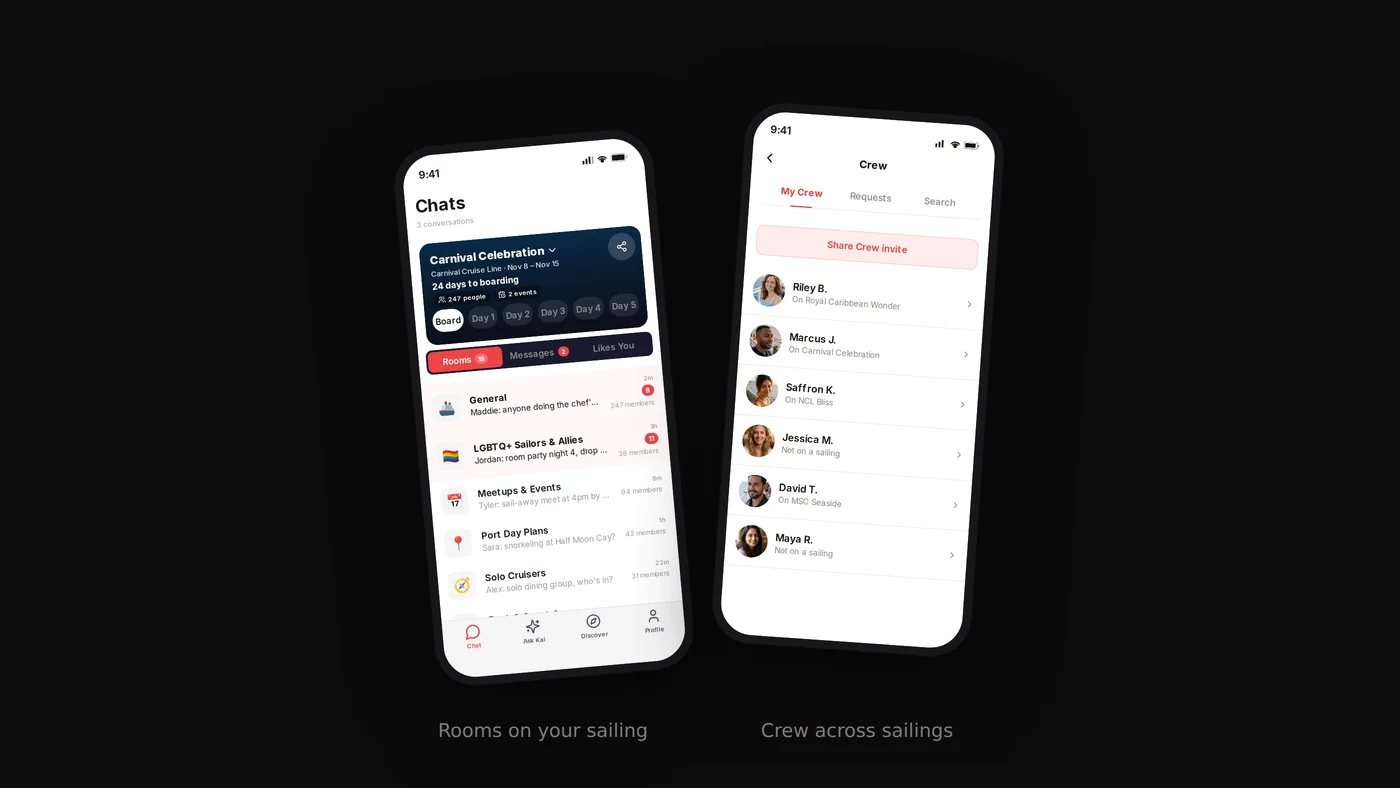
Quick answer: WhatsApp is the default for cruise groups because it is free, already installed, and everyone is on it. It has two specific failures. It needs data, so it stops working the moment you board unless everyone buys a wifi package, which is precisely when the group was supposed to be useful. And joining hands your phone number to every stranger in the group. It is excellent for a crew you already know and a poor tool for meeting people you do not.
Why every sailing ends up on WhatsApp
The pipeline is always the same. A Cruise Critic roll call or a Facebook group forms for the sailing. The thread gets long and hard to follow. Someone posts a WhatsApp invite link, thirty people join in a day, and the real conversation moves there. Nobody decided this. It is just the path of least resistance, and on land it works.
It works because the barriers are all zero. No new account, no download, no learning a new interface, no persuading anyone to try something. That is a genuine advantage and it is why WhatsApp keeps winning these situations.
Failure one: it stops working when you board
This is the one that matters and the one people discover too late.
WhatsApp needs an internet connection. At sea there is no free one. Your options are the ship wifi package, typically sold per device per day or as a voyage plan, or cellular roaming through the ship's maritime network, which is billed at satellite rates and is genuinely expensive. Airplane mode with wifi off is what most passengers actually do.
So on embarkation day, the group that spent two months planning excursions goes quiet. Half the members bought a package, half did not, and the coordination the whole thing existed for stops working during the one week it was for. People end up back on deck-plan meeting points and handwritten notes, which works, but was supposed to be the thing the group replaced.
Worth knowing: ship wifi is usually adequate for messaging and poor for video. If you do buy a package, a text-only plan where offered is often enough. And an app that behaves properly on a slow, high-latency connection will beat one that assumes broadband.
Failure two: your phone number
WhatsApp is built on phone numbers. Join a group of eighty strangers from a public roll call and every one of them now has yours.
A phone number is not a profile. It is often tied to your real name, your other accounts, and a reverse lookup that produces an address. It cannot be revoked from the people who already saved it, and it outlives the cruise. Leaving the group later does nothing about the eighty people who have already had it in their contacts for three months.
The invite link is the other soft spot. Group links posted publicly in a Facebook thread do not expire on their own, are indexable, and let anyone who finds one walk in. Most cruise groups have no idea who is actually in them.
Failure three: eighty people is not a conversation
A roll call group at scale is unreadable. Announcements, packing questions, excursion planning, and small talk arrive in one undifferentiated stream. People mute it. Then they miss the meetup they wanted, which is the outcome the group was formed to prevent.
There is no structure to fix this in WhatsApp. No topics, no per-subject rooms, no profiles to browse, no way to see who else is going without scrolling weeks of history. The community's value is real and it is trapped in a scroll.
What sailings do instead, or alongside
Most groups end up running two things, and that is a reasonable answer rather than a failure.
- Keep WhatsApp for the crew you already know. Once you have met eight people and swapped numbers deliberately, a small group chat is genuinely the best tool for it.
- Use a sailing-scoped app for discovery. Browsing who else is on your ship and date, joining a room by topic rather than one firehose, and messaging without handing over your number is a different job, and WhatsApp does not do it.
That is where Nautir sits. Every sailing gets eight topic rooms rather than one thread, from Solo Cruisers to Port Day Plans to Meetups and Events, each with an events bar for RSVPs. Any member can create a password-protected private room, which is the closest equivalent to a WhatsApp group and does not expose anyone's number. Every member has cleared a government ID scan before they can message you, and 60 percent of people who start a Nautir signup never get past that gate. Chats lock when the cruise ends rather than living in your phone forever.
Nautir will not replace your group chat with the four friends you actually cruise with, and it is not trying to. It replaces the part where you hand your phone number to eighty strangers to find out who is going to the same sail-away party.
FAQ
Do WhatsApp groups work on a cruise ship?
Only if everyone buys a wifi package. WhatsApp needs data, and at sea that means the ship internet plan, which is often priced per device per day. Cellular roaming at sea is billed at maritime satellite rates and is very expensive. So the group that coordinated brilliantly for eight weeks tends to fall silent on embarkation day, which is exactly when you needed it.
Is it safe to join a cruise WhatsApp group?
Joining a group exposes your phone number to every member, and a phone number is tied to far more of your identity than a profile is. In a large group of strangers on a public roll call, assume anyone can save your number, look you up, and keep it after the cruise. Use it for people you have already met, not as a way to meet them.
How do I find the WhatsApp group for my cruise?
They are usually spun out of the sailing Facebook group or Cruise Critic roll call, with someone posting an invite link. That link is the weak point: it is public, it does not expire by default, and anyone who finds it can join.
What is better than a WhatsApp group for a cruise?
For meeting people, a sailing-scoped app where members are verified and your phone number stays private. For coordinating a group you already know, WhatsApp is hard to beat on land and unreliable at sea. Many sailings end up running both.