

Finding a Cruise Cabin Mate: How to Split the Cost Without Taking a Bad Risk
Quick answer: Cruise fares assume two people per cabin, so sailing alone usually means paying a supplement that can double your per-person fare. That is why cabin-mate matching exists. You can find one through a line or operator share program (safest, because the operator does the matching), through a dedicated app feature like CruiseHuddle's CabinShare, or through Facebook and forum posts (riskiest). Whichever route you take, the thing to understand is that a cabin share is not a hotel room split. You cannot walk out at 2am. Vet accordingly.
Why cruising alone costs so much
Almost every cruise fare you see advertised is a per-person price based on double occupancy. The line has priced the cabin expecting two fares out of it, plus two sets of onboard spending, drinks packages, excursions, and casino. One person in that cabin breaks the model, so the line charges a single supplement to make up the difference. A 100 percent supplement, meaning you pay both fares, is common on mainstream lines.
There are real exceptions worth hunting for. Several newer ships have purpose-built solo staterooms sold without a supplement. Repositioning sailings, shoulder season, and longer itineraries more often carry reduced-supplement promotions. Specialist solo operators build their entire product around this problem. None of that changes the underlying arithmetic on a standard cabin, which is why so many solo cruisers go looking for someone to split with.
Where people actually find cabin mates
Four routes, in descending order of how much protection you get.
- Line or operator share programs. A handful of lines and most specialist solo-cruise operators will pair you with another solo traveler, usually same gender, and hold both bookings themselves. This is the safest option by a wide margin because a company with a business to protect is doing the matching and both of you are real, paying, identified customers of theirs. It is also the least available.
- Dedicated app features. CruiseHuddle ships a CabinShare feature aimed squarely at this, and Cruzero targets cabin mates and roll calls as its core job. These put the matching in one place instead of a comment thread. Neither advertises government ID verification, so the app has narrowed your search but has not vetted the person.
- Facebook groups and roll calls. Enormous reach, zero verification, and the thread mixes cabin-share requests with families, logistics, and sales posts. This is where most matches still happen and where most of the bad stories come from.
- Solo cruise Facebook groups and meetup boards. Better targeted than a general roll call, same verification problem.
The risk nobody spells out
Sharing a cabin is routinely compared to splitting a hotel room or getting a roommate. It is neither, and the difference matters.
On land, a roommate situation that turns bad has exits. You leave, you call someone, you find another room, you go home. At sea, for the length of the sailing, you are locked in a small interior space with a person you may have met in a comment thread, on a vessel you cannot get off, in international waters where jurisdiction over an incident is genuinely complicated. Your passport, your money, and your belongings are in that room with them. If the arrangement fails on night one, you have six more nights.
This is not an argument against cabin sharing. Plenty of people do it happily and save real money. It is an argument for doing the vetting properly, because the cost of getting it wrong is much higher than the same mistake on land.
How to vet someone before you agree
- Video call. Not optional. A live video conversation defeats most impersonation. If someone will not do one before you commit to being locked in a room with them for a week, that is your answer.
- Verify them somewhere that checks identity. A profile on a platform with a real identity gate is worth more than a decade-old Facebook account, which proves only that the account is old.
- Book so that you are not financially trapped. Understand who holds the booking, whose name is on it, what happens if one of you cancels, and whether you are liable for their fare. Ask the travel agent or line directly rather than assuming.
- Agree ground rules in writing. Bedtimes, guests in the cabin, drinking, smoking, bathroom schedule, what happens if one of you meets someone. Boring to discuss, far less boring than discovering the mismatch at sea.
- Tell someone at home who you are sharing with and send them the person's real name and booking details.
- Have a fallback. Know what an emergency cabin move costs and whether the sailing is sold out. Ask guest services on day one, not on the bad night.
The alternative worth considering first
Most people looking for a cabin mate are solving two problems at once: the cost, and not wanting to be alone all week. Those can be separated. A reduced-supplement solo cabin plus a sailing where you already know forty people costs more than a cabin share and delivers most of what you actually wanted, with your own door that locks.
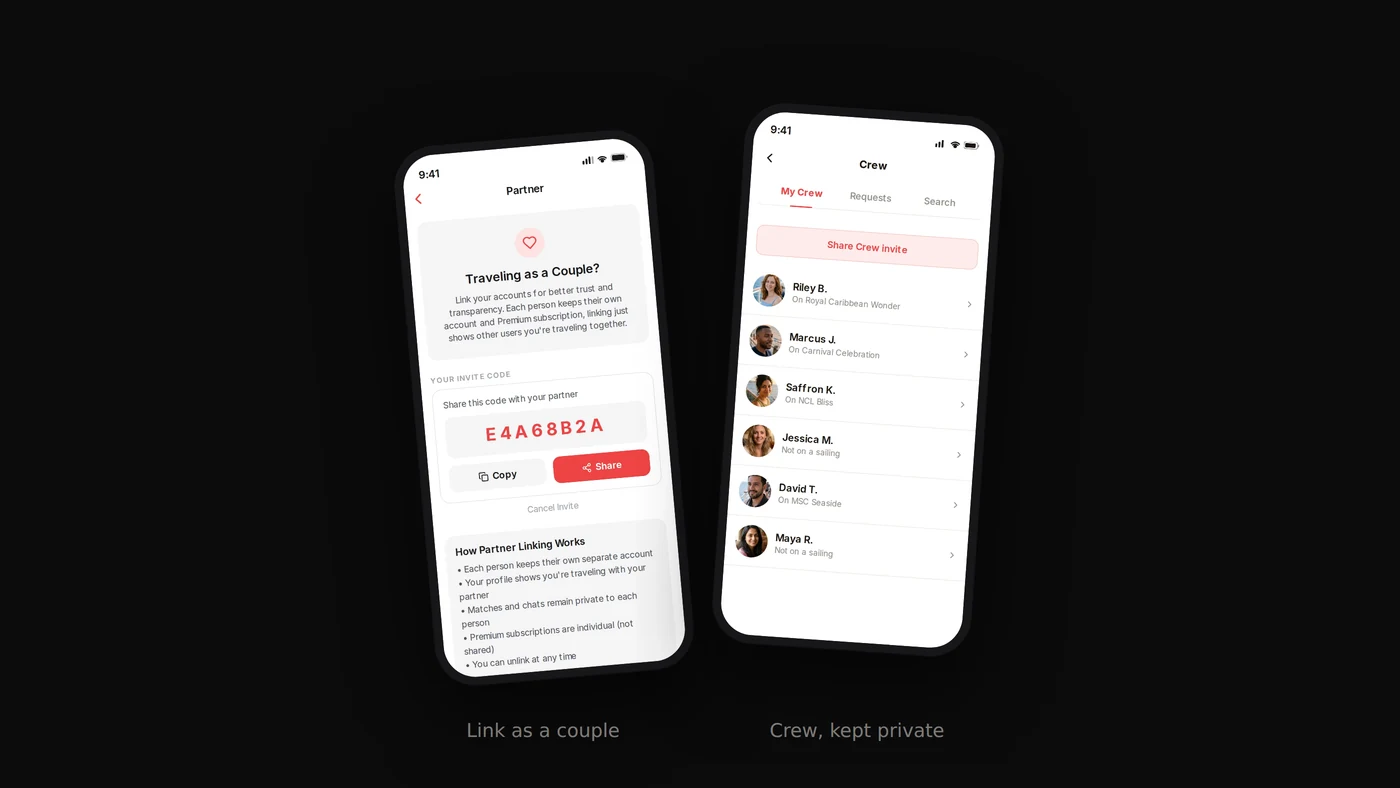
That is the part Nautir does. It will not find you a cabin mate, and it does not try to. It puts you in the Community Rooms for your exact ship and departure date, where every member has cleared a government ID scan, so you can have dinner crews, port day groups, and people to sit with at the sail-away party without sharing a bathroom with any of them. In the last quarter measured, 60 percent of people who started a Nautir signup never made it past the ID gate. Those are the people who would otherwise be answering your cabin-share post.
If the money genuinely does not work without splitting the cabin, share it. Just do the video call, verify them somewhere real, and put the ground rules in writing first.
FAQ
What is the solo cruise supplement?
Cruise fares are quoted per person based on two people sharing a cabin. Sail alone and you are usually charged for the empty berth too, commonly a 100 percent supplement, so the cabin costs roughly double the advertised per-person fare. Some sailings run promotional supplements well below that, and a few ships have purpose-built solo cabins with no supplement at all.
Is it safe to share a cruise cabin with a stranger?
It carries real risk, and more than sharing a hotel room, because you cannot leave. You are in a small locked space with that person for the length of the sailing, at sea, with no easy exit. If you do it, verify who they are independently, video call before you book, agree written ground rules, and never let the arrangement rest on an anonymous forum handle.
Do cruise lines match solo travelers with cabin mates?
A few lines and specialist solo-cruise operators run share programs that pair same-gender solo travelers, and that is the safest version of cabin sharing because the operator handles the matching and holds both bookings. Most mainstream lines do not offer it, which is why the matching has moved to apps and forums.
Does Nautir find cabin mates?
No. Nautir has no cabin-sharing feature and no plans to add one. It is for meeting the people on your sailing, not for arranging who sleeps in your room. If cabin sharing is what you need, CruiseHuddle has a CabinShare feature and Cruzero targets the same job.
What is the cheapest way to cruise alone without sharing a cabin?
Look for ships with dedicated solo cabins, book shoulder season, watch for reduced-supplement promotions on repositioning and longer itineraries, and consider an inside cabin on a newer ship over an ocean view on an older one. A reduced supplement on a sailing you actually want usually beats a cabin share you are uneasy about.